We’re going to try something a little different today. Now that we’ve had a few months reading a simple three-card Tarot spread, I’m going to switch it up and use a spread specific to storytelling and RPGs. A while back there was a game called Querent released via Kickstarter. While the game part of it was a bit thin, mostly consisting of a large narrative Tarot spread, a lot of the supporting Tarot spreads are very good and the book has fantastic resources for interpreting cards in an RPG context. For today, I’m going to use one of the simpler spreads in the book, a six-card ‘Personality Spread’. Once we see what that gets us, I’ll try my hand at turning six card pulls into an interesting character. I’m going to return to my Bianco Nero deck today; as we’re doing something new I want to use cards that are easily readable.
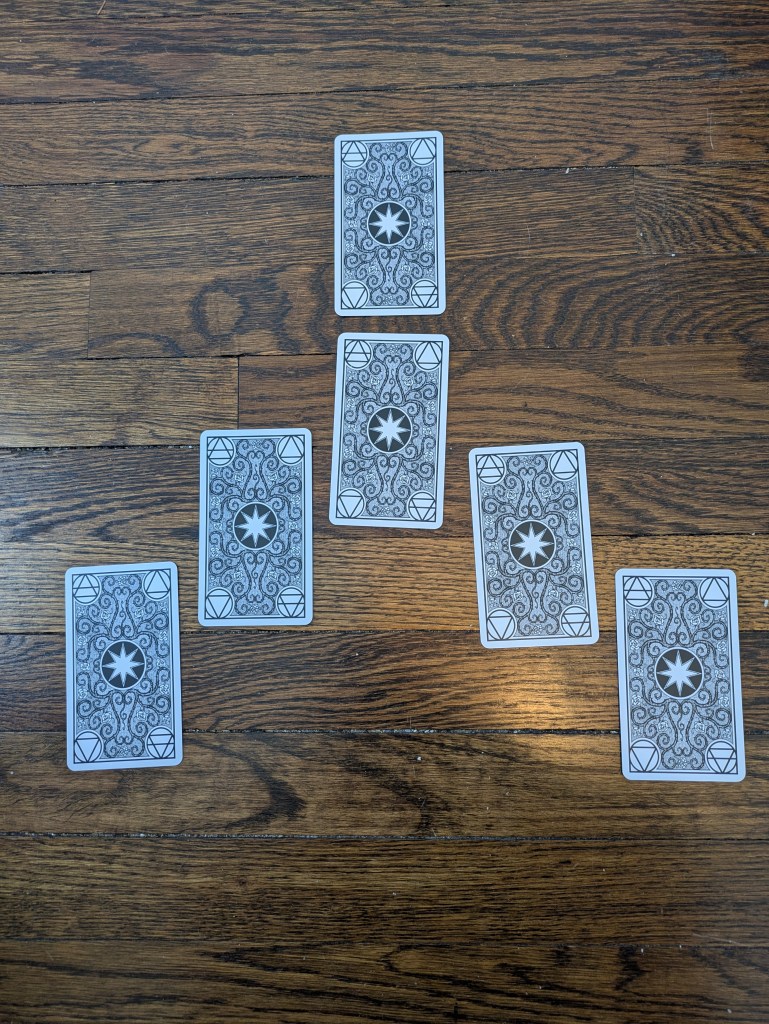
This is a limited deck pull; we’re only using the 22 major arcana for this spread. From the very top we’re going to draw an ‘inward trait’, a truth about the character at their most base level. From there, we go down to a character goal. Going down the left arm we draw a strength and an outward trait, who the character appears to be to other people. Then going down the right arm we’ll draw a flaw and a secret. Let’s take a look at what we have.
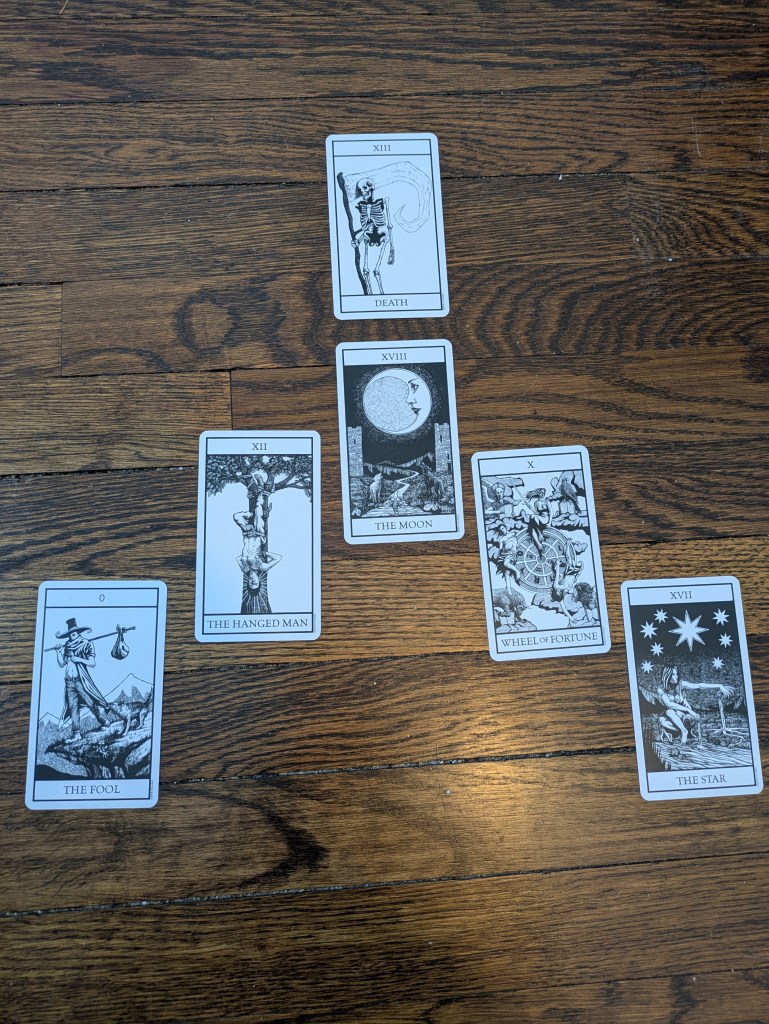
As a note there are no inverted interpretations for this spread, so I’ve turned all the cards upright for readability. For the inward trait we have Death, which the book describes as ‘dissatisfied with oneself and looking for a change’. The goal is The Moon, described as ‘closely following a dream or vision they had’. The strength is The Hanged Man, described as ‘selfless, kind, patient, and interested in the greater good’. The flaw is the Wheel of Fortune, described simply as ‘having bad luck’. The outward trait is The Fool, in the book as ‘childish and adventurous’. Finally, the secret is The Star, listed as ‘knowledge of a brighter future, or potential brighter future’.
The key to spreads like this is that they serve a purpose; they’re there to help you figure out a character and what they’re like. Doing like I did and just drawing the cards without a character in mind doesn’t give you a lot to bound your thought process. In the future I’m probably not going to use this spread without a specific character to create, but I did want to go through the process and see how much information it gave me. Overall, I think there are a lot of interesting touchpoints here, and this does fit well for a character that I’m envisioning as part of some of my worldbuilding.
I mentioned a few weeks ago that I’m working on a new fantasy setting that I eventually want to run a long campaign in. It’s a dramatic expansion of Electric Bastionland, though likely using a more robust game system for mechanics. One thing I’ve started to do, though, is write bits and pieces of history that explain where the city comes from. A big piece of that is the city’s founder.
One of the things that makes history fun is how much bias and perspective can change accounts, and those items are going to be at play for the founder of the campaign’s city. The idea is that the city was founded 500 years ago, mostly due to quick thinking of one person. This was a person who was unwilling to give in to fatalism and nihilism when a global cataclysm struck, and instead, set out for the very epicenter of the disaster, the fresh impact crater where an asteroid hit the planet. Once there, they (and likely some co-conspirators, but who knows how clear the history will be on this!) began work on a geothermal power plant, one of several pieces of technology that would begin a settlement that could survive centuries of dimmed sunlight and cooler temperatures due to the dust thrown up into the atmosphere.
This story fits the cards fairly well, and it does serve to demonstrate that this spread can provide some key elements for a heroic, larger-than-life character. That makes it pretty good for RPG purposes, though it’s clear from the descriptions that this is a starting point, and is much more about creating frameworks and inciting ideas than randomly generating a character.
The Personality Spread is arguably one of the simpler spreads in Querent, both with a small number of cards and also only using the Major Arcana. Still, it’s quite effective in giving you enough starting points and ideas to flesh out a character from first principles. I will go through some of the other spreads in future installments, but those will likely take a bit more wordcount as they generally use more than 6 cards and a bit more interpretation. I’ll also try to bring a scenario along with which to bound the spread, instead of here where the character came somewhat out of thin air and I just so happened to have some writing I was doing where a character would fit.
If you enjoyed this, I would recommend you check out Querent. It doesn’t quite have the procedures to be a standalone game, But the narrative spreads are quite interesting and could certainly be used alongside another resolution system. And, if you’re comfortable enough with Tarot to just make card pulls at any point where the outcome is uncertain, then Querent may actually be enough of a game for you. Either way, keep thinking, keep writing, and I’ll see you next week.