My main interest in starting another site for my writing is to discuss storytelling and generative storytelling. As such, I wanted to anchor it with one of the the most well-known generative storytelling tools around: the tarot card deck. The use of tarot symbolism for divination dates back to the 18th century (although there are many occult myths around the cards that claim much earlier), but tarot as we typically understand and employ it is best dated to the late 19th or early 20th century, around the time that members of the Hermetic Order of the Golden Dawn started writing tarot decks. The Rider-Waite-Smith deck (later just the Rider-Waite deck) has its origins with the Golden Dawn and is still the most popular version around today. Most other variants, like the Thoth deck, owe their basic structure to the correspondences which were written within the Golden Dawn and popularized by figures like Aleister Crowley.
I am not an occultist, nor do I particularly hold faith in any sort of divination. However, tarot cards as they exist today, steeped in symbolism across multiple correspondences, are perfect devices for apophenia, the brain’s tendency to create patterns and narratives out of otherwise random or coincident objects. Tarot spreads, as the patterns of cards used for reading are called, are all structures which encourage the brain to place the symbols into discrete relationships, thereby forming a narrative.
For this month, the first month of the new site and the first tarot spread I’m going to read, I’ll be using a simple three card line. Here, the three cards are intended to represent the past, present, and future. A line such as this makes for a reading with a lot more richness than a single card pull, but nowhere near the complexity of something like a Celtic Cross (I will likely pull a Celtic Cross for some month in the future). The deck for this reading will be my copy of the Bianco Nero Tarot, a beautiful deck with striking black and white artwork.
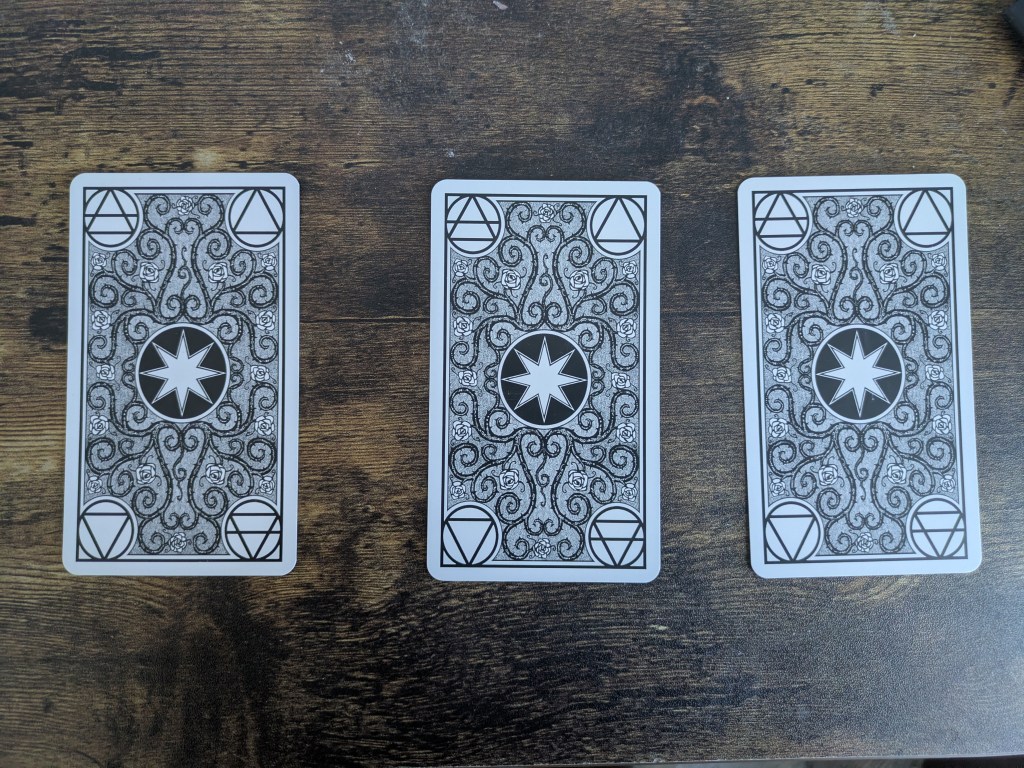
The Bianco Nero Tarot is fairly widely available and reasonably priced, but I think it looks a bit more contemporary than Rider-Waite reproductions. I also have some more out there decks which will be highlighted in future pulls. For now, though, let’s take a look.
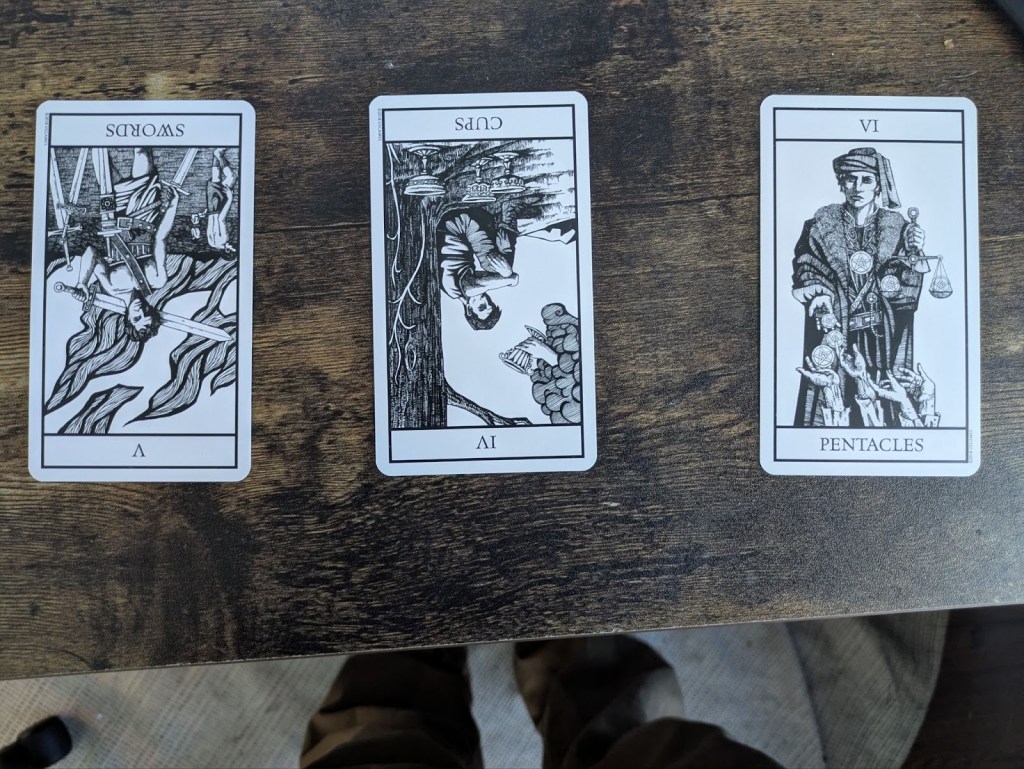
Five of swords reversed in the past position, four of cups reversed in the present position, and six of pentacles in the future position. Starting in the past position, five of swords is a card of conflict and tension; in the upright position it tends to indicate a conflict fought to the bitter end. There are a couple of different interpretations I’ve read of the card reversed, regarding a desire to end conflict or seeing that conflict is something you’ll certainly lose. Another interpretation of the card reversed that I particularly like is that you are no longer fighting that fight, but rather an old wound has been opened, a memory of past conflict. This is particularly apt for the card in the past position.
In the present position is four of cups reversed. Four of cups is a card about new opportunities; in the upright position it is often interpreted as a degree of apathy, an inability to act on the opportunities given you. In the reversed position it is very much the opposite, searching for a new start, new opportunities, and looking for a change or new inspiration. In the future position is an upright six of pentacles; the card shows a man with a scale handing out his coins to outstretched hands coming from below. As implied, the card is indicating magnanimity and generosity, and generally in reference to good works and helping others.
I’m going to take the direct route in interpreting this spread. We move from old wounds, memories of the past, through to new opportunities and looking for inspiration, and then to a future of helping others. When looking to my position specifically, this spread is about writing, and therefore about this site. I have spent years trying and failing to write fiction, only really succeeding with the necessary degree of self-discipline in the last few years. I am now creating a new opportunity, trying to write more and approach my writing differently through this site, and using it to capture the inspiration I do have from gaming and other sources. In the future, I hope that I will have built up enough of an audience and a network to help others get off the ground as well.
The end state of this read may not be particularly inspiring or interesting, it just seems to feed into my intent of starting off this site. And that’s fine! That is what’s on my mind, after all. I did draw those cards cold, but given what each of them referenced, the story fit back into my current work fairly well. I have been reading tarot occasionally for about the last seven years or so, though I’m still a novice; you’re likely to see more engagement with symbolism and the other correspondences of the cards as I continue to read more regularly.
As I mentioned earlier, I have a solid handful of tarot decks and also know a number of spreads, both traditional divination spreads as well as some designed specifically to be employed in storytelling. We’re going to keep it simple to begin with, but soon enough I’ll move on to Celtic Cross spreads, character spreads, and some other fun tarot tools that can be employed for storytellers. For now, we have the first spread for a new website, and a somewhat self-referential read about my thoughts regarding where it could go. Tarot reading is a mental exercise, and as you (or I) do more of it, interpretation will come more naturally and lead to a wider number of places. That is the true talent of a fortune teller, after all: the cards don’t tell the future, but the story woven between the reader, the person being read, and the cards may lead to a new understanding or consideration of the past and present that better presages the future.
Today, take a step to consider how the trajectory of your past and present will lead to your future. Using a tool like a deck of tarot cards may not produce unseen revelations, but it will get you to think about events in your life differently than if you just think along the same lines you always do. Hopefully you find a new, fruitful approach; as for me, I have some writing to do about new approaches, as well as some new fiction. I’ll be back with a new post next week.


 New Wonk Media